
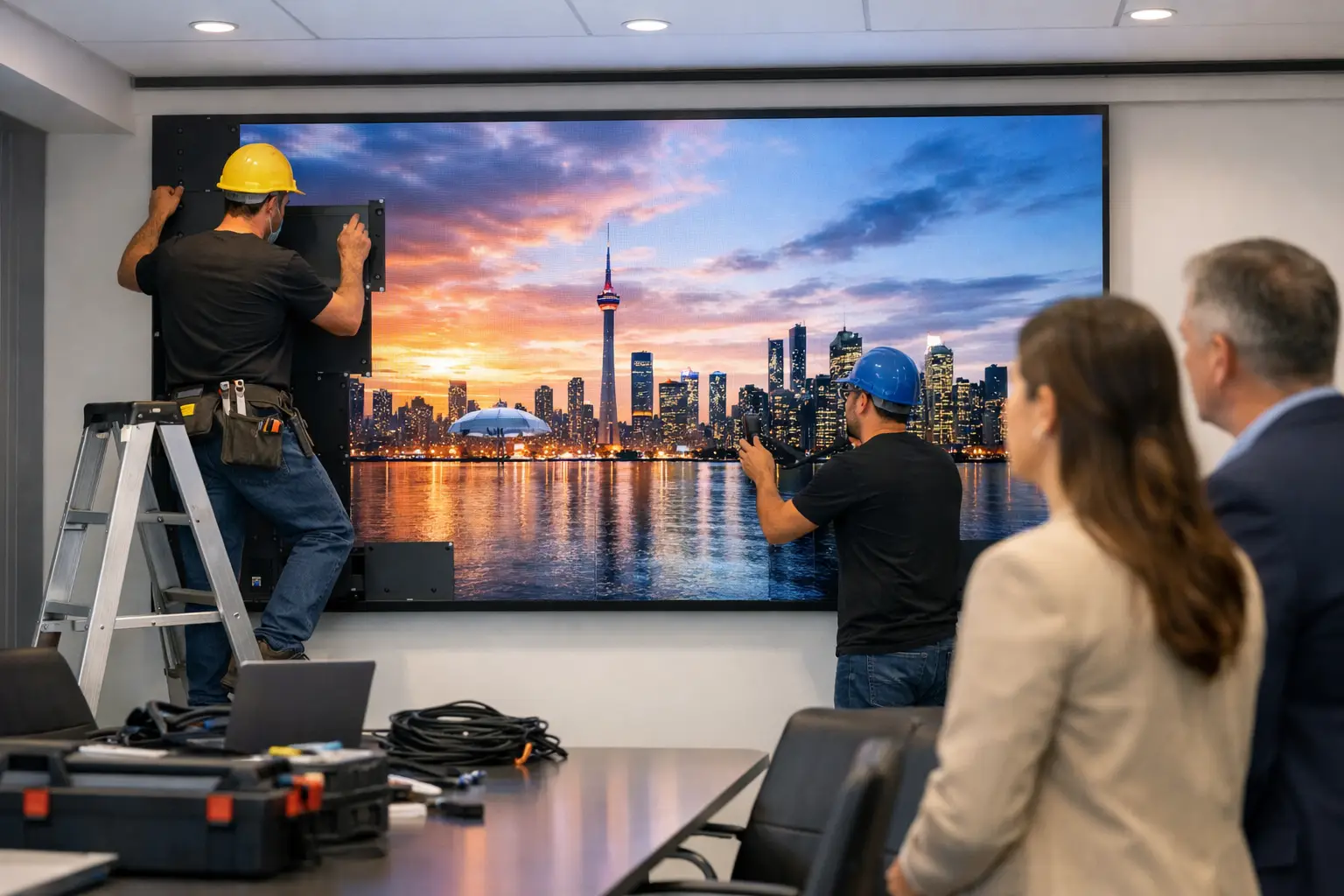
A poorly planned reception display is easy to spot. Visible joins, awkward brightness, content that looks sharp from one angle and washed out from another – all of it signals a project that focused on the screen first and the workplace around it second. That is why led video wall installation should never be treated as a simple product purchase. In most organisations, it is a design, infrastructure and usability project rolled into one.
For workplaces, the question is rarely just which LED wall to buy. The real question is how to install a system that looks impressive, works reliably every day, fits the physical environment, and does not create extra pressure for internal IT or facilities teams. That takes more than screen dimensions and a price per square metre. It takes proper planning from the start.
What led video wall installation really involves
An LED video wall is often chosen because it solves problems that conventional displays cannot. It can fill large spaces without the size constraints of standard screens, cope better with high ambient light, and deliver visual impact in reception areas, town hall spaces, showrooms, briefing suites and auditoriums. For many organisations, it also supports a stronger visitor experience and clearer internal communication.
However, installation is where performance is won or lost. LED technology is modular, which gives flexibility, but it also introduces variables. Pixel pitch affects viewing distance. Mounting structure affects alignment. Power, heat, ventilation and access affect long-term support. Content resolution affects whether the finished display feels premium or disappointing. If any of those are treated as afterthoughts, the result can look expensive without delivering the expected value.
The workplace factors that shape the right solution
In a commercial environment, the best LED wall is not always the largest or the brightest. It is the one that suits the space, the audience and the day-to-day use case.
A reception installation has different demands from a boardroom backdrop or an all-hands presentation space. In reception, image quality at close range and architectural finish tend to matter most. In a larger presentation area, sightlines, audio integration and control simplicity may matter more. In a multi-purpose space, the wall may need to support presentation content one day and branded messaging the next.
Room conditions also matter. Natural light, ceiling height, reflective surfaces and available wall depth all influence what can be installed successfully. So does the building itself. In older offices or listed environments, access routes, structural limitations and electrical capacity can shape the project just as much as the display specification.
That is why early site assessment is so important. It prevents a situation where an impressive concept reaches the technical design stage and then has to be compromised because the wall cannot support the weight, the ventilation is inadequate or the chosen pixel pitch is wrong for the actual viewing distance.
Planning an LED video wall installation properly
Good projects usually start with a clearer brief than simply “we want a video wall”. Stakeholders need to define who will use it, what will be shown, how often content changes, who controls it, and how critical uptime is.
From there, practical design decisions become easier. The display size should be driven by room geometry and content needs rather than guesswork. Pixel pitch should be selected according to typical viewing distance. If people will stand close to the wall, finer pixel pitch becomes more important. If the display is viewed primarily from across an atrium or large room, a different balance may make better commercial sense.
Content planning deserves more attention than it usually gets. A well-installed wall can still disappoint if existing assets are stretched, cropped badly or not designed for the display’s native resolution. This is particularly common in corporate spaces where the wall is expected to show a mix of branding, dashboards, town hall presentations and video calls. A practical installation plan considers how those sources will actually appear on screen and what processing or content management tools are needed.
Control is another point that often separates a successful workplace system from a frustrating one. If users need multiple remotes, complicated switching steps or technical support for routine tasks, adoption will suffer. In most organisations, the right answer is a simple interface that lets non-specialist users launch the required source or mode without thinking about the underlying system.
Common issues that undermine results
One of the most common problems in led video wall installation is treating the wall as an isolated display rather than part of a wider AV and workplace technology ecosystem. The screen may be excellent, but if it is not integrated with presentation systems, room controls, audio, conferencing platforms or content workflows, the user experience becomes inconsistent.
Another issue is underestimating service access. LED walls need maintenance access, whether front serviceable, rear access or a hybrid approach. If that is not considered early, even minor support tasks become disruptive and expensive. The same applies to power distribution and cable management. A clean finish is not just aesthetic. It affects reliability, safety and future support.
Brightness can also be mishandled. Buyers sometimes assume that higher brightness is always better. In reality, it depends on the setting. In a sunlit atrium, stronger output may be essential. In a boardroom or internal collaboration space, too much brightness can be uncomfortable and reduce image quality. The installation needs to be tuned for the environment rather than specified in isolation.
Then there is the issue of disruption. For occupied offices, installation methodology matters. Delivery routes, out-of-hours work, noise, dust, ceiling access and commissioning windows all need proper coordination. A technically sound project can still be poorly experienced if workplace operations are not considered.
Why installation quality matters as much as the display
LED video walls are unforgiving when installed badly. Even small alignment issues can be visible across a large surface. Inconsistent module calibration can affect colour uniformity. Poor mounting tolerances can create visible imperfections that undermine the premium look organisations expect.
This is where experienced project delivery becomes essential. A good installer is not only fixing panels to a wall. They are coordinating structural requirements, electrical works, signal distribution, control integration, commissioning and final calibration. They are also thinking ahead to supportability, user training and handover.
For many organisations, that joined-up approach is more valuable than chasing the cheapest hardware cost. A lower upfront price can quickly lose its appeal if the wall is difficult to maintain, awkward to operate or not properly integrated into the workplace.
A consultative approach reduces risk
For UK organisations investing in workplace technology, the safest route is usually a consultative one. That means assessing the use case, surveying the space, modelling the viewing conditions, planning infrastructure, and making sure the finished system is usable for the people who actually need it.
It also means being honest about trade-offs. A finer pixel pitch may improve close-up viewing, but it will affect budget. A flush architectural finish may look better, but it can add complexity to installation and service access. An all-in-one control approach may simplify operation, but it needs proper design and testing upfront. These are not reasons to avoid ambitious projects. They are reasons to make informed decisions.
This is where a specialist integrator adds value beyond supply. The role is not just to install equipment, but to align technical decisions with business use, operational realities and long-term support. That is particularly important for organisations with multiple stakeholders across IT, facilities, workplace teams and leadership.
Getting the result right for the long term
A successful LED wall should still feel like the right decision years after installation. That depends on more than picture quality on day one. It depends on whether the system is easy to manage, whether staff are confident using it, and whether support is available when issues arise.
Training and documentation are often overlooked, yet they make a real difference. If front-of-house teams, facilities staff or meeting room users understand how to operate the wall properly, the system becomes part of the workplace rather than a specialist asset that only one person can manage. Ongoing support matters too, especially where uptime is business-critical.
For organisations planning an LED wall, the strongest results usually come from slowing down the early decisions. Define the purpose clearly, assess the environment properly, and choose a delivery partner that understands the workplace as well as the technology. That is how TecInteractive approaches projects of this kind – with a focus on practical design, dependable delivery and systems that people can actually use.
The best LED video walls do more than look impressive. They fit the space, support the message, and work without drama long after the launch day photographs have been taken.